Showing posts with label Academic. Show all posts

Saturday, April 10, 2010

Tip #39: Save Everything

This tip is courtesy of my friend and classmate Matt.

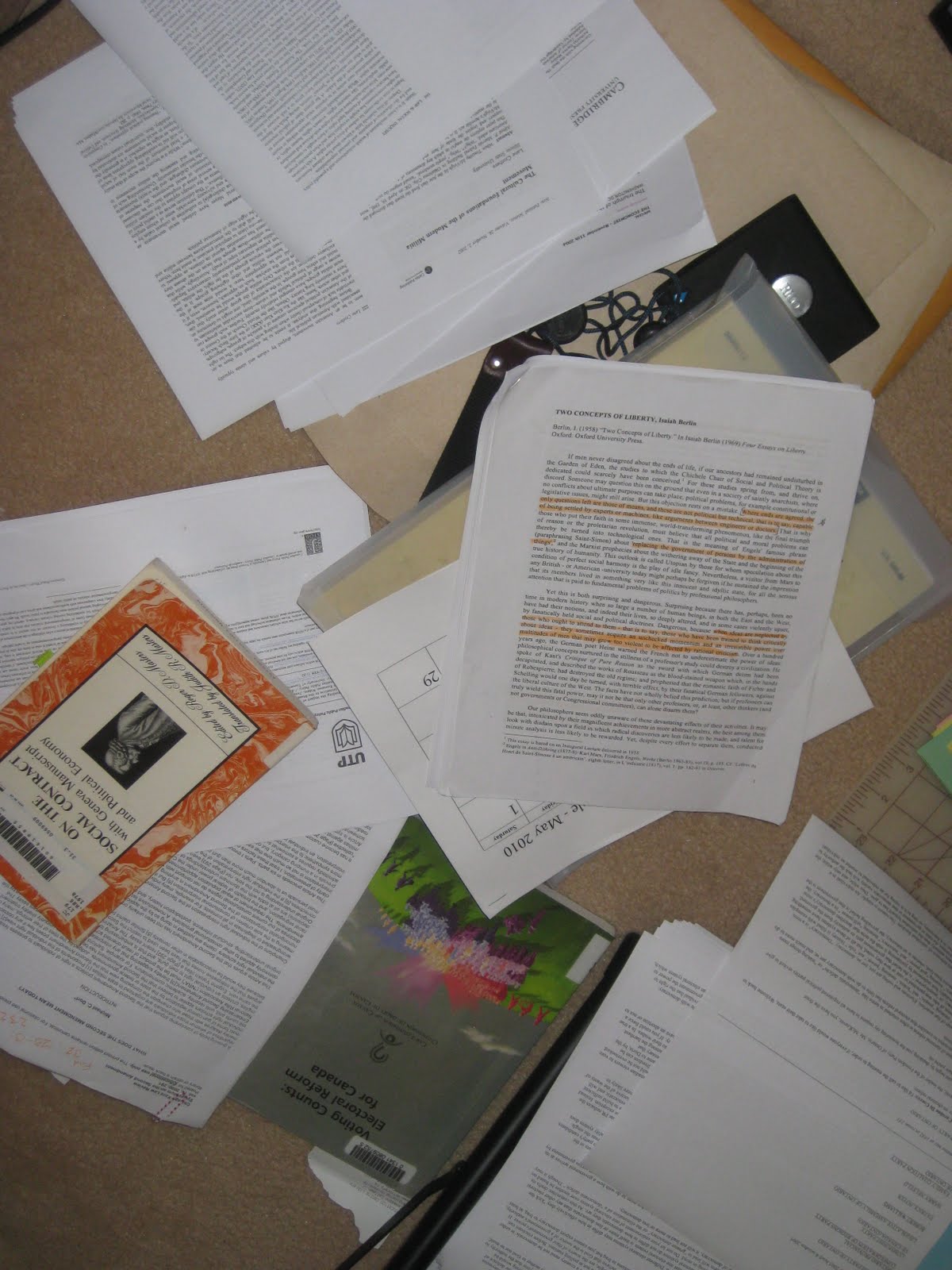
Save Everything - old lecture notes, journal articles, research notes etc.

You never know when it may come in handy. I've found that the same journal articles can sometimes be useful for more than one paper, especially as you advance through the year. I've even had cases where we'll read the same article in another class, so I've been able to just pull out my copy of the journal article with my highlights and notes already in the margins!

Just one note, however, is not to self-plagiarize. You can reuse articles or research, but obviously don't copy and paste into your new paper. That's still plagiarism at this level.

Tip #39.2 - Organize said notes... so they don't look like this...
.. or this...

Thursday, April 8, 2010

Tip #38: Use the Reference/Help Desk at the Library

I'd like to introduce you to some people who will make your life sooooo much easier: They are our library's help desk staff. The list of things they can help you with is unending:
  • ordering interlibrary loans
  • searching for journal articles (in print and online)
  • finding and using microfilms
  • finding newspapers, journals and other non-book resources
  • can't find a book in the stacks (they help me with this ALL the time!
  • etc. etc. etc.
I am also told that you can book a one-on-one research appointment. If you don't know where to start, then this is certainly the place to go for answers.

If you can't go see them in person (say you're home on reading week or something), I would recommend the Library's website (www.eclibrary.ca), or this fantastic hand-out on Library Tips: http://www.nipissingu.ca/library/remository/LibraryTips.pdf

Sunday, April 4, 2010

Tip #36: Reference as you go

It's paper season over here at Nipissing. All our final papers are coming due, and although it would make sense not to procrastinate and get things done early, it never happens.

However, I do have one tip that will make your life soooooo much easier - Reference as you go.

Nothing is worse then getting to the end of that massive paper and then realize that I haven't been writing out your footnotes. This means you have to go back through all your sources and find the citations, which may take just as long as it took you to write the paper.

So, my advice is to write out the citation immediately. Even if you aren't going to format it perfectly, write out where you got the information, especially the author and page number, so you don't have to go back looking for it.

The worst experience I've had with this is realizing that I didn't reference something, and had already returned the book to the library. Bad news! By now, I've learned better (it only took four years...)

Thursday, April 1, 2010

Tip #35: (Don't) Take a Directed Studies

This year, I took a directed studies course. Essentially this entails writing a massive paper, but no classes. Most students that do a directed studies (and this is a teny tiny percentage of the student population) will do it in their third or fourth year. This year, I thought a directed studies would be a fun way to learn about something I was interested in, but could not take as a course at Nipissing. I also figured that it would be a good precursor to grad school. I've still got mixed feeling about directed studies courses though. Here's why:

DON'T take a directed studies course if you like to procrastinate. This was my major problem with directed studies. No due-dates until the end of the year just begs for procrastination. I also think I had some preconceived notion that it would be an easier class because I didn't have to attend lecture, write exams etc. This is most certainly not the case. You will read more than in a regular seminar course and just because you aren't in class three hours a week does not mean that you aren't doing the same amount of work. There were points during this directed studies that I was ready to just scream because I had left work until the last minute, and had a meeting with my supervisor and was scrambling to produce something.

DO take a directed studies course if you plan to go to graduate school. I think I learned more about self-directed learning and discipline than the actual content of the directed studies course. I've learned to anticipate when I'll be busy, and do my work ahead of time. I've also learned that I need to set my meetings with my advisor before I'm actually done the work as a way to motivate me to get things done by a deadline. I'm glad I've learned this stuff now, instead of next year in graduate school. In addition, because I took this directed studies course, I'm not nearly as afraid of a 50 page MRP (major research paper - for the MA level). I've learned to split papers of this size into distinct parts and then work on each as if they were a stand-alone essay. It makes the paper so much more manageable and less scary.

So I leave this one up to you. It's a great experience in getting to know your independent working style. Nevertheless, it will drive you crazy at times, so be sure you can handle it along with your other classes or else you may set yourself up for failure.

Friday, March 26, 2010

Tip #33: It's OK to skim every once in a while.

Shh.... I have a secret... don't tell anyone... but...

It's OK to skim every once in a while.

There will be times during your university career (oh say, fourth year) when you will be expected to read a book a week... per class. Although I would strongly encourage you to read everything, some weeks it's just not going to happen because of other commitments and schoolwork.

In these exceptional cases, it is OK to skim. Professor K calls it a "reconnaissance mission." Open the book, get what you need, and get out. Here's how:

Start by reading the table of contents and introduction. This will give you a good overview of what the book is going to be about. Don't read it leisurely, go on a mission to get the thesis (ie. what the author wants to prove with the book), and how they plan to prove it. Often, you will also be able to find a brief overview of the other chapters. Then, skip right to the conclusion and do the same thing. Make sure that the same thesis you found in the introduction is there. This is the bare minimum you can do to just survive a class in the pinch.

The next best thing is to "get your feet wet" in each of the chapters. Some chapters have specific intros and conclusions which are helpful, but usually you'll just have to skim into each of the chapters to get a sense of what's going on. If you still have time, you can read full chapters, basing which ones you choose based on the overview in the introduction. Read chapters that might be pertinent to the themes of the class.

What you should strive for, however, is to read the entire text and think critically. Come prepared to class with questions of things you didn't quite understand, important or interesting passages. Be sure to have the answer to the question: "What is the author's thesis?" It will be asked.

Some other things to consider. You just can't skim when it comes to philosophy or theory texts. You'll just have to suck it up and read the whole thing, or else you will be completely lost. I would also just like to remind you that skimming is just a fall-back when everything doesn't quite get done. If you plan to be in class, then you should plan to have done your readings.

Monday, March 22, 2010

Tip #31: Consider Spring and Summer Classes

Random useless fact about Holly: I started taking summer classes in grade 11 of high school. I couldn't find a job that summer, so instead I got special permission to take an introductory Canadian History class at Nipissing. I did the same the next summer, and got another 6 credits in Canadian Social History. Ditto for the summer of first year university, when I took the Ancient History Course.

The moral of the story is that I had 18 extra credits towards my degree before I started 2nd year! And the result is I will be able to graduate with a double major (history and political science), minor (French) and teachable (in music). Moreover, I was able to take one less class in my last year, so that I could really concentrate on those honours seminars (and trust me, you will need the time).

In addition, I found it so much easier to concentrate on my schoolwork when I only had one class. For example, during my social history summer class, which was every morning (Mon-Thurs), I could go to class in the mornings and then read and study in the afternoons. I was always on top of my readings because there was no room for procrastination. I also couldn't procrastinate on papers, since I knew they would be due in a matter of weeks.

This being said, I have never taken one of those online summer courses - I have a sneaking suspicion that I would find it very hard to motivate myself when the course was so independent.

Although most students will have to work during the summer - if you're so lucky as to have a job that can allow you to take a course, or even if you can't find a summer job - do something productive and try out a spring or summer class. I think you'll be pleasantly surprised.

Photo caption: 16-year-old Holly at Nipissing, summer of grade 11.

Friday, March 12, 2010

Tip #29: Buy Cheaper Textbooks

I guess this tip isn't exactly relevant right now, since the school year is almost over, but I still thought I'd share some tips on how to get textbooks for cheaper prices.

Obviously, the cheapest option is to buy used. The first place to look is on the bulletin boards at school. There are quite often signs advertising used textbooks on general notice boards. Another way to buy used textbooks is to log onto facebook marketplace. I've sold quite a few of mine this way. You simply check out what's for sale on the Nipissing network, and you may get lucky and find your book. There are also sites that buy and sell used textbooks -I have a friend who tried abebooks.ca and had success finding a French textbook. (On a side note, if you want to sell your textbooks, try selling them to abebooks.ca, it's actually very easy. You probably won't get quite the price that you would if you sold them through notice-boards etc. but it saves time). If all else fails, the Nipissing bookstore has used textbooks alongside the new textbooks, but you have to make sure you buy early before all the used ones are gone!

If you like to go for new textbooks (like me), I would first suggest ordering from amazon.ca. Their prices are usually the best (I often compare to indigo.ca, since I have a Chapters Rewards Card, but Amazon is still better). Plus, if you order more than 35$ (which is always the case for me when I'm ordering my textbooks for the year), you get free shipping. The one drawback is that you really have to order them right when the book list comes out in the summer. However, you can cancel your order at any point before the books are shipped, so if they don't get shipped by the time you need them, you can buy them at the bookstore. The last option, of course, if the campus bookstore. Although generally more expensive, the bookstore does provide an important service to students, contributes financially to the school, and are pretty much guaranteed to order in your textbooks.

Sunday, March 7, 2010

Tip #27: Go to office hours at least once

Not to get all sentimental about Nipissing, but one of the best things about this place is that the professors always find time for you! We call this our "open door policy." I've had professors who have read over drafts of my paper, helped me understand difficult texts and sometimes just had time to chat about politics (and if it's Professor Toivo - over tea!).

One of my professors at Cornell gave us the advice that you should always go to office hours at least once for each class and I think it's a good suggestion. It can be intimidating, but generally Nipissing profs are really welcoming during their office hours. Your mark can only go up if you take the time to get your professor's input before the assignment is due.

Another reason you should really take advantage of office hours is that because you will find that some questions just can't be answered in class, whether it's a personal situation that's impeding your school progress, of if you still don't "get it" and don't want to disrupt the class for the 16th time.

An added bonus is that your prof will know you better when it comes time for references... say for grad school...

Friday, March 5, 2010

Tip #26: It's never too early to do (and present) research


My first academic conference presentation was at Cornell's Undergraduate Research Conference in 2009 (see picture!). I presented on a paper I had written about French-Canadian participation in the Canadian militia leading up to WWI. Before I showed up at the conference, I was a bit nervous about what it would be like. I got my TA to do a run-through with me, but of course, he prepared me for the worst. Academic conferences are actually pretty cool. It's neat once you realize that you've done so much research that you are really the expert on the topic (well... that could also be because no one knew about this particular topic in the US... hmm...).

So, my next tip (to go around with the series of "it's never too early to..." tips) is to try presenting a research paper at a conference. Not sure where to start? How about the Nipissing University Undergraduate Research Conference! Abstracts (so like a paragraph summary of your research) are due on March 15th, and the conference takes place on March 26th and 27th. If you're interested, or want more information, then email Professor Earl at hearl@nipissingu.ca

Wednesday, February 24, 2010

Tip #23: Use a Planner

I would recommend this one to anyone - not just university students!

My planner is absolutely essential to my academic success! It helps me remember assignments, meetings and work commitments. I like to use one of those ones that opens like a calendar, so that I don't get surprises when I flip pages to the next week (since you've got a whole month on a page).

Along with my planner, I keep myself organized is by making a colour-coded spreadsheet at the beginning of every week, detailing hour-by-hour what I have planned. It's actually a great system that I'd recommend to anyone. You can't forget things when they are staring at you in bright colours! It's also easier to see spaces that will be good for study time. There are also online planner/schedule-thingys that I know some people use if you're more high-tech!

Friday, February 12, 2010

Tip # 18: Read during the Summer or on Break


yeah.... Reading Week!!!!
I'm not exactly doing anything interesting on Reading Week, but it's still a super chance to get caught up and even work ahead.... which leads to tip #18: Read during the Summer or on Break.

If you are in an arts program, there will be lots and lots and lots of reading. Especially when you hit 4th year, you'll be averaging about three books a week (considering class and project reading). I still haven't figured out the best way to do this, but I do have one suggestion of how to make it a bit easier...
Once the book list is up for my classes, I order them from amazon or indigo online so I'll get them before class starts. During those last few weeks of summer, before things get crazy with school, I try to get through as much of the reading as I can. One important thing to remember is to make good notes (I type them) so that a few months later, instead of re-reading the whole book to prepare for seminar, you can just re-study your reading notes. This made a huge difference for me this year, especially for my History seminar.

The same can apply for Reading Week or Christmas break - it takes discipline to be reading academic stuff over your holiday, but I just keep in mind how much better things will be later on if I'm proactive with my reading now.

So, the plan for my Reading Week is to conquer the large/dense book for my poli sci seminar so I can concentrate on my paper for those last three weeks of class instead!

Saturday, February 6, 2010

Tip #15: Go to Class

I absolutely love my classes this year. I'm taking a seminar on early American history, another seminar on political philosophy, applied music, French and a directed studies course....

But at some point in your university career, you will definitely get a class that you just can't sit though without getting bored. In first year, it's also tempting not to go to class because no one is taking attendance.

Nonetheless, I would encourage you to go to every class. It will certainly save you study time, since you can draw on your experiences in class for exams and assignments. Better to let the prof explain difficult concepts to you than struggle with them last minute. This is where the best learning will happen, and let's face it - if you're not at university to learn, then you've got to recheck your priorities.

Professor Mulburger (a Nip prof who blogs!) points to a link from an American prof who often gets "Do I need to know this?" and responds "You can survive without the things you learn in college. People survive scrounging out of dumpsters and sleeping in doorways. If you want to talk about quality of life, we need to be a bit more demanding." (www.uwgb.edu/dtuchs)

But what about those overly boring classes that you just wish you could snooze through? Taking notes will have you stay focused. Also try participating in class discussions - that will make the time fly. You will also want to come prepared to class with the readings done so you can intelligently follow along (although I'm sure you've heard that one before). I think one of the most common reasons a student will "tune out" is because it just doesn't make sense. If, after asking lots of questions, it still doesn't make sense, then talk to your professor or Academic Services about getting some help.

Monday, February 1, 2010

Tip #12: Primary Sources Rock!

First of all, Happy February!

Second of all, while we're on the topic of sources and libraries, I'd like to share another piece of research-based advice: primary sources rock!

If you're new to the 'university' thing, then a primary source is quite simply "original, first-hand accounts" while secondary sources are "second-hand, published accounts" (and yes, I did just quote that from the National Archives of Canada website.) So for example, in history a primary source could be a diary, newspaper article, map or photograph from the time period I am examining, while a secondary source is an article or book that a scholar wrote about the time period.

One way to impress your professors off the bat is to use primary sources. Why just take what others have said about the topic when you can go to the source?! It may seem daunting at first, but there are so many online resources you can use. If you don't know where to start, take a look at the primary sources the articles or books you are reading have used. They will provide bibliographic information, and then you can also look it up and read it for yourself. Sometimes you may run into the problem that the source is not available online (and Nipissing doesn't have access to a lot of non-electronic primary sources). Some ideas (for history or poli sci at least are to try archives from different countries, Hansards (or parliament proceedings) historical newspapers you can get through the e-resources at Nipissing, or museum websites - they are all online!

Using primary sources puts your paper into the A category (in my opinion) because it shows that you can critically evaluate a source and draw your own conclusions. Not sure which conclusions to draw? Just bring the source you found to your prof during office hours and they will most certainly help you out!

I really wish I had realized the vast amount of primary sources I could have been using right from first year. They really do make the difference between high school and university-level research.

Saturday, January 30, 2010

Tip #11: Learn to Interlibrary Loan Early

Here's another one of those 'learned this the hard way' tip: learn how to interlibrary loan (I.L.L) early - both early in the sense of learn how in your first year and also early as in weeks before you need the books.

We all know Nipissing has a crummy library. We also know that ordering books from another library takes time and is annoying since you can't renew them. But, alas, we must make do with the situation we're in.

So my suggestion is to learn to I.L.L. right away. It's so easy to set up an account with "RACER" the program that does I.L.L.s You can go to the library webpage for a step-by-step guide, or ask a librarian for a hand-out, OR the librarian will actually help you do it your first time (as was my case). Once you have an account and know how, you can order books from all sorts of libraries online from your home, and the library will email you when it comes in.

Since I've found that one of the best ways to find good solid sources for papers is through bibliographies of articles and books, I use the I.L.L system a lot. Nipissing usually doesn't have the specific books that I'm looking for. You may also not know that this service is free and also works for specific articles.

But something to keep in mind is that it will take a week or so for your book to come in. I also learned last week that they can be recalled by the lending library at any time. So my experience has been to order as early as possible (once I know my topic) and to write thorough notes, so you don't get into the experience of needing an I.L.L book a week before the paper is due.

Friday, January 22, 2010

Tip # 7: Back up your files

So it's the weekend and besides attending the rally against the prorogation of parliament and church on Sunday, my plans exclusively include writing papers! I not only have massive papers for my two honours seminars (in poli sci and American history) but I have a directed studies course that I choose to do as well. I have a whole stack of books that I've been going through ever so slowly, and this weekend I'm going to start writing the next section!

All these papers leads me to tip #7. I've learned this one the hard way...

Here's how it all happens: You're a page away from finishing that massive paper you've been working on for months. Then suddenly, your computer crashes. Everything is lost. (Insert much crying here).

It only has to happen once for you to start backing up your files. There are a few ways to back up files. The easiest has to be memory sticks or external hard-drives. Another option is emailing it to yourself, this way you can access it on any computer.

So I urge you to back up your files all the time, especially when you're working on a paper. Once you're done a section, paragraph or even a fantastic sentence, back it up!

Wednesday, January 20, 2010

Tip # 6: When going to the library, dress in layers

Speaking of dressing for the weather...

One thing you will realise (or maybe already have realised) is that the Nipissing/Canadore Library has an unpredictable climate. Depending on the area of the library you are sitting in, what time of day it is and a variety of other factors (which may or may not include whether the dude who runs the heating system at Nipissing misread -20 degree to be 20 degrees), the library may be super warm or super cold. My advice (and the advice many students will tell you) is to dress in layers. This way you can add multiple sweaters or take them off.

Nipissing is building a new library with Canadore, which I will never actually see since I'm due to graduate (and even if I stay here for grad school, it won't be open until the end of that year). But maybe since it's a stand-along building it will be able to control it's own thermostat!

The Learning Library Concept Drawing

Saturday, January 16, 2010

Tip # 4: Appy for Everything

It's such a wonderful feeling... I am totally done my graduate school applications! It has dragged on for the better part of a year (including choosing schools, writing the GRE, writing statements of interest/personal statements, filling out forms, asking people for references, mailing packages, ordering transcripts... it's a lengthy process.

This leads me to Tip #4: Apply For Everything. I'm of the opinion that every scholarship/award/school will accept someone, so it might as well be you. I obviously don't suggest spending all your spare time applying for things, and I certainly wouldn't advocate applying for things that have fees (some scholarships have massive application fees... I'd be skeptical about these ones), but if there's a scholarship/award/fellowship that sounds appealing, and there's not cost but your time, go ahead and apply.

This applies to (no pun intended) prospective students as well... there are all sorts of scholarships to apply for, so do as many as you can. I'd say the priority though has to be those scholarships and awards from the school you intend to attend, since you'll have a much better shot than the national awards. Also consider how many of each scholarship are awarded; if it's one in Canada then perhaps your time is better spent elsewhere if you aren't a stellar student and haven't saved the world yet.

After applying to a few awards/scholarships/schools, it does get easier. For example, you can just copy out that list of awards you've already written and can cut and paste paragraphs from essays. However, be careful to tailor each essay to its application procedures and guidelines. They will be able to tell if you cut and paste the whole thing. Make sure you speak to what they are looking for in applicants. My professor always tells me not to be subtle, make sure it's staring the committee right in the face.

So go ahead and apply, apply, apply... You may be pleasantly surprised and you'll never know unless you try.

Wednesday, January 13, 2010

Tip # 2: When choosing a laptop, "light" is key.

Most students buy laptops when they start university. The advantages are many: they have come down in price, make taking notes a breeze and are so much more portable than desktops!

I got my laptop (this old beast that I'm typing on right now) in the Spring of Grade 12 (which was in 2006). Back then, I didn't know much about laptops, so I let my brother pick for me. It's a Toshiba Satellite (the early kind). It has served me well for the past four years, but is going to stop working for good probably within the next year. It's super super slow now and gets hit by viruses and whatnot really easy. Someday I think it's fan's just going to go on overdrive and die.

But my main complaint about my laptop is the weight. For 2006 laptops, it's not all that clunky, but today you can get much lighter laptops, and tip #2 to new students is to get as light a laptop as you can! My laptop travels on my back (I'd suggest a packsack case, or else one shoulder is going to suffer) to classes, work and even on trips and after a while it sure makes your back sore. Since most students live more than a minute from school, you will be carrying the thing long distances and muscles will hurt because of it. My next laptop (whenever that happens) will be the best quality light laptop I can afford!

The 2006 Toshiba Satellite

Monday, January 11, 2010

Tip # 1: Go on Exchange

I'll probably end up talking about my experience abroad quite a bit, so here's tip #1: Go on an Exchange. Last year, I had the opportunity to study at Cornell University with a Killam Fellowship for the Winter/Spring Semester. It was most likely the best experience of my life! Not only did I get to take some fantastic American politics and history classes, but I also met some amazing people, tried out all so many of new things (including rock climbing, swing dancing and living on my own), and traveled around the USA. The Killam Fellowship program, along with a lot of assistance from Nipissing University, family, and all my savings made this experience possible!

While the Killam program was not a traditional exchange, I would encourage any student, especially at Nipissing University, to study abroad, do an international internship, or study on a fellowship. Sometimes the courses you'd like to take aren't offered at Nipissing (case-in-point, you can count the classes on American politics and history at Nip on one hand), so an exchange provides you the opportunity to take a greater diversity of classes. Furthermore, although some will say "it's just the US," any foreign country will provide you an opportunity to reflect on what makes Canada great, while also learning about (and learning to love) your host country.

I think one of the things that most impedes students who want to go on exchange is cost, but if you keep your grades up and take an interest in what's going on around campus, there are fellowships (like mine), international internships (like my friend Matt did) and even bursaries/scholarships to help with exchanges. Plus, if you do a traditional exchange, you only pay Nipissing tuition (unlike mine, where I had to pay full Cornell tuition... hence the crazy cost).

You can contact Melissa in the Nipissing International Office (inside the Office of Student Development) if you want to find out more!